
02 · STORAGE
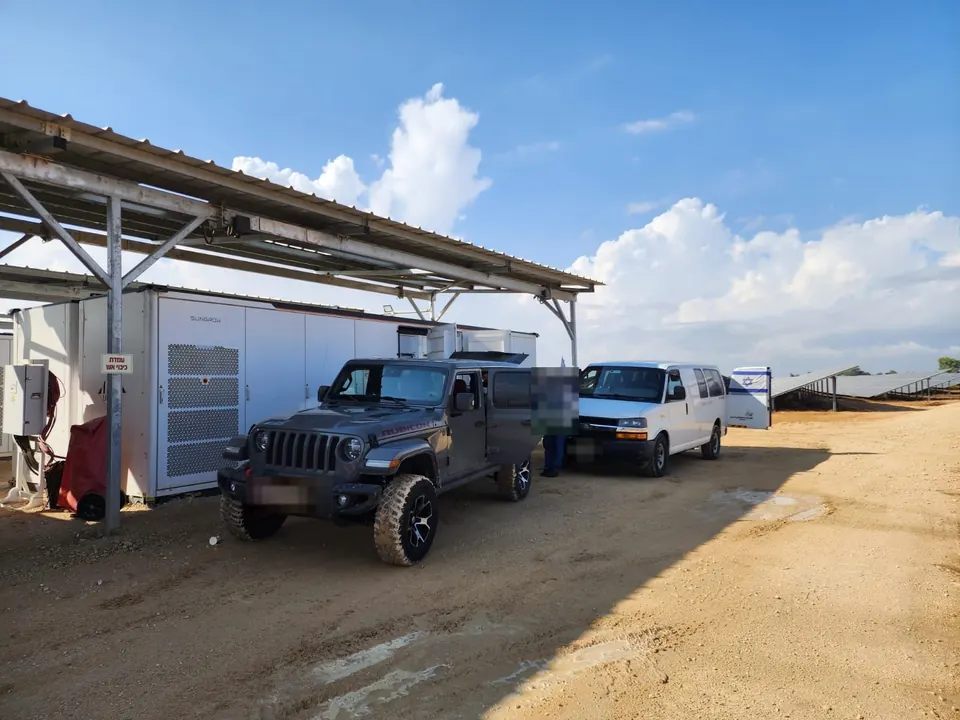
Storage & Energy Centres
Storage makes solar energy available at peak hours and at night, and adds backup for grid outages. We design and build the electrical side of storage systems — boards, cabling, protection, inverter integration and testing — and integrate them with existing or new solar systems.
02 · SIMULATOR
One day with a battery
Watch hour by hour how energy flows between the panels, the battery, the building and the grid.
Where the power comes from
| Hour | Solar direct | From battery | From grid | Consumption |
|---|---|---|---|---|
| 00 | 0 | 6.7 | 0 | 6.7 |
| 01 | 0 | 6.7 | 0 | 6.7 |
| 02 | 0 | 6.7 | 0 | 6.7 |
| 03 | 0 | 6.7 | 0 | 6.7 |
| 04 | 0 | 6.7 | 0 | 6.7 |
| 05 | 0.8 | 5.9 | 0 | 6.7 |
| 06 | 6.3 | 3.7 | 0 | 10 |
| 07 | 16.7 | 0 | 0 | 16.7 |
| 08 | 26.7 | 0 | 0 | 26.7 |
| 09 | 30 | 0 | 0 | 30 |
| 10 | 30 | 0 | 0 | 30 |
| 11 | 30 | 0 | 0 | 30 |
| 12 | 26.7 | 0 | 0 | 26.7 |
| 13 | 30 | 0 | 0 | 30 |
| 14 | 30 | 0 | 0 | 30 |
| 15 | 30 | 0 | 0 | 30 |
| 16 | 26.7 | 0 | 0 | 26.7 |
| 17 | 20 | 0 | 0 | 20 |
| 18 | 8.3 | 5 | 0 | 13.3 |
| 19 | 1.4 | 8.6 | 0 | 10 |
| 20 | 0 | 10 | 0 | 10 |
| 21 | 0 | 6.7 | 0 | 6.7 |
| 22 | 0 | 6.7 | 0 | 6.7 |
| 23 | 0 | 6.7 | 0 | 6.7 |
Battery charge
| Hour | Battery charge |
|---|---|
| 00 | 73.2 |
| 01 | 69.6 |
| 02 | 66.1 |
| 03 | 62.5 |
| 04 | 59 |
| 05 | 55.8 |
| 06 | 53.8 |
| 07 | 54.6 |
| 08 | 58 |
| 09 | 67.1 |
| 10 | 82.1 |
| 11 | 100 |
| 12 | 100 |
| 13 | 100 |
| 14 | 100 |
| 15 | 100 |
| 16 | 100 |
| 17 | 100 |
| 18 | 97.3 |
| 19 | 92.7 |
| 20 | 87.4 |
| 21 | 83.8 |
| 22 | 80.3 |
| 23 | 76.7 |
Backup during an outage
Default: 20% of peak consumption
02 · CAPABILITIES
What we do
Storage electrical design
Sizing to consumption and connection, with boards, protection and cabling design.
Integration
Connecting batteries to inverters and the solar system, and configuring operating and backup modes.
Energy centres
Grid, solar, storage and generator combined in one board and one control.
Testing & start-up
Full electrical testing, start-up and performance follow-up after installation.
02 · IN DEPTH
In depth
What a battery storage system is made of
It starts with the cell: cells are joined into modules, and modules are mounted in racks or in a container. The battery management system (BMS) watches the voltage of every cell and the temperature of every module, balances the cells so they stay at the same state of charge, and disconnects the battery when anything goes outside its permitted range. LFP (lithium iron phosphate) is a common chemistry in stationary batteries.
The power conversion system (PCS) is a bidirectional inverter that links the battery to the building’s supply: it charges the battery from the solar system or the grid, and discharges it to the building. Above it, the energy management system (EMS) sets the strategy: self-consumption of solar surplus, shifting energy into the evening, shaving consumption peaks, or holding a reserve for backup in a power cut.
There are two ways to connect a battery to a solar system. AC-coupled, the battery has its own inverter and connects at the switchboard; DC-coupled, it joins the DC side of a hybrid inverter that it shares with the panels. In the simulator above, you can switch between two strategies, self-consumption and saving for the evening, and see how the energy flow changes over the day.
Sources: IEC 62619:2022 · UL 9540A
A day with a battery: moving energy from noon to evening
At midday, a solar system often produces more than the building is using at that moment. Instead of exporting the surplus, the battery charges from it, and in the evening, when the sun sets but consumption goes on, it discharges and supplies the building. In the simulator, the evening window of the “save for the evening” strategy is 17:00–23:00, and you can follow hour by hour where the power comes from.
Choosing a battery means telling two numbers apart. Power, in kW, sets how fast it can charge and discharge. Energy, in kWh, sets how much it can store. Their ratio is the C-rate, C = P / E: at 1C the battery empties in one hour. Not all of the capacity is usable: the energy available is the nominal capacity times the depth of discharge, and the simulator always keeps a 10% reserve, a 90% depth of discharge.
Every charge and discharge loses some energy. The simulator assumes a round-trip efficiency of 88% AC to AC, a planning assumption between PNNL’s two figures: its 2022 assessment gives about 86% AC to AC and 89.6% DC to DC. Backup time in an outage is the usable energy times the discharge efficiency, divided by the critical load, and backup works only if the battery’s power is at least the critical load. The backup calculator in the simulator above does this sum.
Sources: PNNL, 2022 Grid Energy Storage Technology Cost and Performance Assessment · IEC 62619:2022
Storage safety: the layers of protection
Storage safety is built in layers, from the cell to the building. The first layer is chemistry: LFP cells are more thermally stable than other common lithium chemistries. Next comes the battery management system, which cuts off before a cell leaves its safe range; then thermal management, which keeps the cells at the right temperature; detection of gas, smoke and heat; suppression and ventilation; and finally spacing between units, so that a fault in one unit does not spread to the next.
In Israel, the Electricity Administration’s guidelines for installing battery storage systems (2021) require the designer to assess the risks of hazardous emissions, overheating, explosion and fire, and to decide from that assessment where the system goes and whether it needs ventilation, cooling and suppression. They also require a free passage of at least 0.6 m from a wall or other installation, and where an RCD protects the inverter’s supply line, it must be type B unless one of the guidelines’ exceptions applies.
Among US standards, the UL 9540A test method checks whether thermal runaway in one cell spreads to neighbouring cells, modules and units, and NFPA 855 covers the installation of stationary energy storage systems. We plan the location, ventilation and spacing according to the Israeli guidelines, the manufacturer’s instructions and the test results of the equipment.
Sources: Israel Electricity Administration, guidelines for installing battery energy storage systems connected to the distribution network (2021) · UL 9540A · NFPA 855
02 · PROCESS
How it works
- 01
Consumption review
Analysis of consumption, peak hours and the existing connection.
- 02
Design & proposal
System design and an itemised proposal.
- 03
Permitting & coordination
Coordination with the utility and the required parties.
- 04
Build & integration
Installation, connection to the existing system and configuration.
- 05
Start-up & follow-up
Testing, start-up and performance follow-up.
02 · CLIENTS
Who it is for
- Factories and retail
- Agriculture and farms
- Public buildings
- Homes with a solar system
02 · FAQ
Frequently asked questions
How long will the battery last in an outage?
It depends on three things: the usable energy in the battery, the discharge efficiency and the load to be backed up. Backup hours are usable kWh × discharge efficiency ÷ critical load in kW. The battery and inverter power must also be at least the critical load, and the inverter must support backup. In the backup calculator in the simulator above, you can enter a critical load and get an estimate.
What is the difference between kW and kWh in a battery?
kW is power: how fast the battery can charge or discharge at any moment. kWh is energy: how much it can store. The ratio between them is the C-rate, power divided by energy: a battery that delivers its full capacity in one hour is working at 1C. Power decides which loads can run together; energy decides for how long.
How many years does a battery last?
Battery life is counted in cycles, and it depends on the depth of discharge. PNNL’s 2022 assessment, based on manufacturer data, puts LFP at about 2,400 cycles at 80% depth of discharge and about 4,500 at 70%. The number of years depends on how many cycles the battery runs a day, and also on calendar ageing, which goes on even when the battery is idle; warranties differ from one manufacturer to another. The simulator above shows the equivalent full cycles per day.
Can a battery be added to an existing solar system?
In most cases, yes, usually AC-coupled: the battery gets its own bidirectional inverter and connects at the switchboard, without replacing the existing solar inverter. Before that we check the existing inverter, the switchboard and the installation location, and handle the approvals needed to connect a storage system to the grid.
CONTACT
Want to hear more?
Leave your details and we will come back with a proposal that fits your site.